

Sam Davis writing for Apostoic Venn
One From Many
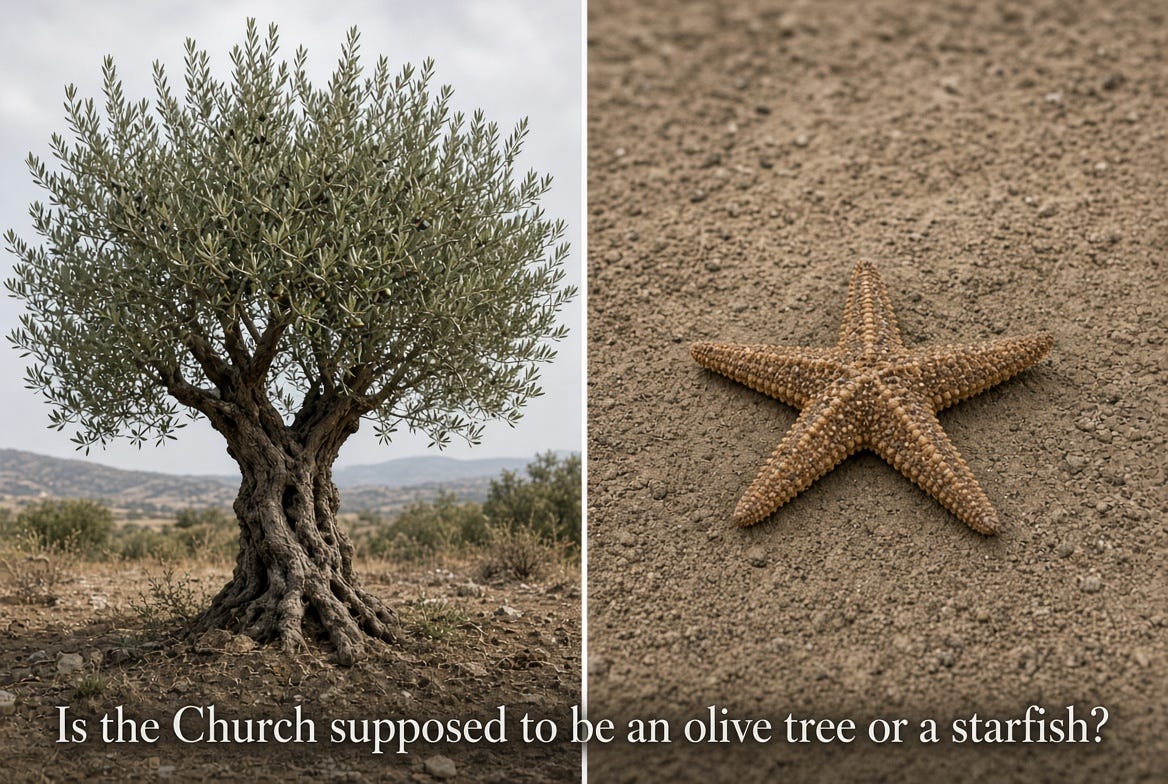
Once there was an olive tree who thought he was a starfish… I’m actually not very good with parables, but you should get the point. Romans 11 says that Christ’s church is an olive tree. Christ being the root of this tree; the Jews are the native branches; and the Gentile Christians are “wild” olive branches grafted into Christ’s tree. The original E Pluribus Unum.
The olive tree is a beautiful depiction of a truth Paul describes elsewhere in these words, “Here there is not Greek and Jew, circumcised and uncircumcised, barbarian, Scythian, slave, free; but Christ is all, and in all.“
But what if we’ve spent the last 500 years pretending we’re entirely the wrong thing? The olive tree can adopt desperate, doomed, isolated branches and integrate them into a unified life. The starfish is famous for being completely the opposite. You can cut a starfish into a dozen pieces and, given enough time, you’ll end up with twelve identical, mature, autonomous starfish.
How Did We Get Here?
Well, it’s all Marin Luther’s fault, of course… In all seriousness, I cannot look back at the Reformation and say it was anything other than necessary. And my stance on that will become apparent momentarily as we review the concepts of the essential and the important.
However, today is not the 1500s, and the theological climate has shifted in ways which demand that we reconsider our old boundaries:
In this case, the expression ‘Co-redemptrix’ does not help extol Mary as the first and foremost collaborator in the work of Redemption and grace, for it carries the risk of eclipsing the exclusive role of Jesus Christ…
Mary’s contribution to human salvation, specifically the title of “Co-Redemptrix” (“Co-Redeemer”) has been a point of theological debate for decades — with proponents calling for Mary’s role in redemption to be declared a dogma but critics saying it exaggerates her importance and could damage efforts for unity with other Christian denominations.
https://www.ncregister.com/cna/vatican-nixes-coredemptrix-titles-of-mary
And that from the mouth of a Catholic!
The Way Things Should Be
Sometimes the disparity between the way things are and the way things should be is so stark that stating the case inherently states the problem.
“I do not ask for these only, but also for those who will believe in me through their word, that they may all be one, just as you, Father, are in me, and I in you, that they also may be in us, so that the world may believe that you have sent me. The glory that you have given me I have given to them, that they may be one even as we are one, I in them and you in me, that they may become perfectly one, so that the world may know that you sent me and loved them even as you loved me.”
John 17:20-23 ESV
Some concerning items which present themselves to my attention:
Jesus Christ has one Church.
The oneness of His Church is founded in and akin to the oneness of the Godhead.
Jesus gave us His glory so that we would be one.
Jesus gave us this oneness so that the world would believe that the Father sent the Son.
Jesus gave us this oneness so that the world would know that the Father loves the one Church even as He loves the Son.
Do these items describe the state of modern Christianity?
The Way Things Are
Sometimes, we can be so inured to the way things are (even when we know they’re wrong) that we can’t imagine what things would be like if they were right. Where does that leave us?
This problem is so big, so obvious, so old, so accepted… that I’m just going to continue on my merry way, and let it sort itself out. Because that’s what problems do right: they solve themselves…
I’m not certain our generation is responsible for solving this problem, at least not yet. But we are definitely responsible to make an honest assessment of where we are, where we should be, plot a path between those points, and make progress along that path.
Jesus Christ Has One Church
Since this is true, we must give expression to this truth. Christianity must be, and present itself, as unified rather than sectarian.
I appeal to you, brothers, by the name of our Lord Jesus Christ, that all of you agree, and that there be no divisions among you, but that you be united in the same mind and the same judgment. For it has been reported to me by Chloe’s people that there is quarreling among you, my brothers. What I mean is that each one of you says, “I follow Paul,” or “I follow Apollos,” or “I follow Cephas,” or “I follow Christ.” Is Christ divided? Was Paul crucified for you? Or were you baptized in the name of Paul?
1Corinthians 1:10-13 ESV
Some read Paul’s words here and conclude: “denominations are sinful”. I think that’s an oversimplification to the point of being incorrect. Christians naturally self-organize along the axes which are important to Christianity. This is a normal, human behavior: humans in a large group share a primary interest and then subdivide according to related, secondary interests. Calling this sinful would relegate much innocent action into sinful categories. I think the consideration of sin enters at a different point. When it is expedient, convenient, or necessary, can we then work and worship together?
Doesn’t Play Well With Others
While I cannot forego the opportunity to point at the sectarian spirit and denounce its childish nature, I must simultaneously underscore that its magnitude is grave.
For anyone who eats and drinks without discerning the body eats and drinks judgment on himself. That is why many of you are weak and ill, and some have died.
Have you ever sat in a worship service of denomination A and the preacher says from the pulpit that he will not fellowship, will not worship, will not do ministry nor evangelism with Christians from denomination B? “They’re my brothers in Christ, but I can’t talk to them or work with them.” What madness is this?
But I, brothers, could not address you as spiritual people, but as people of the flesh, as infants in Christ. I fed you with milk, not solid food, for you were not ready for it. And even now you are not yet ready, for you are still of the flesh. For while there is jealousy and strife among you, are you not of the flesh and behaving only in a human way? For when one says, “I follow Paul,” and another, “I follow Apollos,” are you not being merely human? What then is Apollos? What is Paul? Servants through whom you believed, as the Lord assigned to each. I planted, Apollos watered, but God gave the growth. So neither he who plants nor he who waters is anything, but only God who gives the growth. He who plants and he who waters are one, and each will receive his wages according to his labor. For we are God’s fellow workers. You are God’s field, God’s building. According to the grace of God given to me, like a skilled master builder I laid a foundation, and someone else is building upon it. Let each one take care how he builds upon it. 1 Corinthians 3:1-10 ESV
Perhaps we are not so fastidious in any other area of life as we are about our denomination. Our friends can enjoy and think differently as long as there is “enough” common ground between us. When was the last time you screened your employer based on his eschatology? We go to work to get paid, and as long as the environment is tolerable in proportion to that pay, we can put up with a lot of variance.
Our purpose in Church is to be served by and to serve the Lord Jesus. Since our bond to fellow Christians is rooted in the impreshible blood of Christ, and since we can tolerate significant disagreement at work with less common ground, we therefore should be eager to defer to and make peace with our brothers. Anything less is hypocrisy.
What if the question of where to attend church was oriented around “where can I do the most good for the kingdom of God” rather than “which church is my favorite echo chamber”?
When The Cure Is As Bad As The Disease
In some circles “ecumenism” is almost a byword, and I understand why. Not that long ago Americans gave the world an example of exactly how not to be ecumenical.
The 1920s saw the expansion of theological liberalism in the US. Pearl S. Buck distilled and disseminated the ideas of the prior generation of German liberals like Albrecht Ritschl and Friedrich Schleiermacher.
I would summarize the conservative response of the moment as throwing the baby out with the bathwater. In the interest of feeling and being unified, they boiled Christianity down to five truths they all agreed on, and they stopped talking about the rest. But Christianity is more than just five facts. Once there was no skin nor muscles nor sinews to hold the bones together, then within two generations, the defending denominations had lost the war of attrition and succumbed to the tides of liberalism. They were unrecognizable. They’d become the liberals they had banded together against.
History shows us that abandoning doctrine is a non-solution. It obliterates the foundation of faith and leaves us all standing on the same nothing.
The In-Crowd
When most of American Protestantism was zigging against the liberals, there was one group that zagged. Instead of abandoning their doctrinal niceties, they made a bulwark of them. I don’t want to name and shame, but I spent some of my early Christian years in this particular denomination. They see doctrinal exaction as one of the hallmarks of spiritual maturity. Looking back on my time in this denomination, I have the feeling of being among the star-bellied-sneeches.
They weren’t making the same mistakes as the rest of American Protestantism; they were making all their own mistakes. I once witnessed a four-hour Synod debate over a preaching license candidate: whether he was a Sabbath-breaker for playing football with his son on Sunday after church. The only thing worse than the in-fighting was the out-fighting.
History shows us that making an idol of our doctrinal peculiarities is another non-solution. Those who think this way tend toward the cultish perspective that “We’ve got Christianity right, and no one else does.”
Both groups of our predecessors began from the premise that doctrinal precision and ecumenism are mutually exclusive. The one abandoned doctrine for a false ecumenism. The other abandoned ecumenism for doctrinal exaction.
A Way Forward
What if doctrinal precision and ecumenism are perfectly compatible? What if the incompatibility occurs at a different point? What if pride and ecumenism are incompatible? If that’s true, we must first humble ourselves and determine to obey Jesus Christ by being the one Church that He has bought with His blood.
I submit that our next step forward, our next step toward true doctrinal ecumenism, is to categorize Christian doctrine into the essential and the important. The essentials define disagreements outside Christianity, while the important is everything else, defining disagreements within Christianity.
When there’s a disagreement within the Church, then my God has commanded me how to behave toward His children. When the disagreement is outside the church, my God has commanded me how to behave toward those who are not yet His servants.
But I do not presume I am important nor intelligent enough to distinguish Christianity’s “essential” doctrines from its “important” ones. Rather, I point to the ancient creeds of the Church: The Apostles’ Creed, The Nicene Creed, The Athanasian Creed. These were written by the greats of the Christian faith, and God’s people have spoken them with one voice for thousands of years. In fact, these creeds were written specifically to exclude heretical pretenders by formulating exactly what those would not say. Therefore, if a man will stand before God and speak the creeds, I will treat him as a brother, and vice versa.
For Your Consideration
I have read over one hundred theology textbooks in my Christian years, and there are at least two doctrines which I see in the Scriptures, but I don’t remember ever reading of them in theology texts. I only mention them now because I think that believing and doing them is foundational to an ecumenism which embraces doctrine. Furthermore, as the first to speak of them, I claim the right of nomenclature. Therefore, I dub these the holy doctrines of nunya-ology and zipit-ology.
Once we’ve read the Creeds and separated the doctrines of Christianity into the essential and the important, then nunya-ology and zipit-ology are part of how we humble ourselves, making and preserving peace within Christ’s Church.
Even a surface reading of Romans 14 teaches me: I am not the master of that man over there, and he will not answer to me for every little thing he does and believes. Therefore, if my point of disagreement with him is only important and not essential, then I should be quick to realize it’s probably none of my business, and I’ll just shut up about it.
Is Anyone Doing Any Of This Right?
In the 20 years I’ve been a Christian, I’ve made a circuit of numerous denominations: Southern Baptist, Presbyterian, Non-Denominational, Pentecostal, Episcopal, and Lutheran. While my experience is anecdotal, it’s relatively broad, and my education is broader still.
When I read the Presbyterian Westminster Standards, they feel like an attempt to draw a line in the sand between “us Christians” and “them Christians”. By contrast, the Anglicans’ 39 Articles of Religion read like an attempt to draw a circle with as many Christians inside as possible.
It is my opinion that the Reformed Episcopal Church, part of the Anglican Church in North America, part of the Global Anglican Future Conference, has adopted some of the most forward-thinking (or perhaps retrospective is a better word) standard operating procedures for handling concerns like cross-denomination pulpit fills, watch care membership, visiting or transferring to a new denomination, and cross-denominational ministry efforts. I applaud them in this regard.
The Apostles’ Creed
I believe in God, the Father almighty, creator of heaven and earth.
I believe in Jesus Christ, his only Son, our Lord, who was conceived by the Holy Spirit and born of the virgin Mary. He suffered under Pontius Pilate, was crucified, died, and was buried; he descended to hell. The third day he rose again from the dead. He ascended to heaven and is seated at the right hand of God the Father almighty. From there he will come to judge the living and the dead.
I believe in the Holy Spirit, the holy catholic church, the communion of saints, the forgiveness of sins, the resurrection of the body, and the life everlasting. Amen.
The Nicene Creed
We believe in one God, the Father almighty, maker of heaven and earth, of all things visible and invisible.
And in one Lord Jesus Christ, the only Son of God, begotten from the Father before all ages, God from God, Light from Light, true God from true God, begotten, not made; of the same essence as the Father. Through him all things were made. For us and for our salvation he came down from heaven; he became incarnate by the Holy Spirit and the virgin Mary, and was made human. He was crucified for us under Pontius Pilate; he suffered and was buried. The third day he rose again, according to the Scriptures. He ascended to heaven and is seated at the right hand of the Father. He will come again with glory to judge the living and the dead. His kingdom will never end.
And we believe in the Holy Spirit, the Lord, the giver of life. He proceeds from the Father and the Son, and with the Father and the Son is worshiped and glorified. He spoke through the prophets.
We believe in one holy catholic and apostolic church. We affirm one baptism for the forgiveness of sins. We look forward to the resurrection of the dead, and to life in the world to come. Amen.
The Athanasian Creed
Whoever desires to be saved should above all hold to the catholic faith. Anyone who does not keep it whole and unbroken will doubtless perish eternally.
Now this is the catholic faith:
That we worship one God in trinity and the trinity in unity, neither blending their persons nor dividing their essence. For the person of the Father is a distinct person, the person of the Son is another, and that of the Holy Spirit still another.
But the divinity of the Father, Son, and Holy Spirit is one, their glory equal, their majesty coeternal. What quality the Father has, the Son has, and the Holy Spirit has.
The Father is uncreated, the Son is uncreated, the Holy Spirit is uncreated. The Father is immeasurable, the Son is immeasurable, the Holy Spirit is immeasurable. The Father is eternal, the Son is eternal, the Holy Spirit is eternal. And yet there are not three eternal beings; there is but one eternal being. So too there are not three uncreated or immeasurable beings; there is but one uncreated and immeasurable being.
Similarly, the Father is almighty, the Son is almighty, the Holy Spirit is almighty. Yet there are not three almighty beings; there is but one almighty being. Thus the Father is God, the Son is God, the Holy Spirit is God. Yet there are not three gods; there is but one God. Thus the Father is Lord, the Son is Lord, the Holy Spirit is Lord. Yet there are not three lords; there is but one Lord.
Just as Christian truth compels us to confess each person individually as both God and Lord, so catholic religion forbids us to say that there are three gods or lords. The Father was neither made nor created nor begotten from anyone. The Son was neither made nor created; he was begotten from the Father alone. The Holy Spirit was neither made nor created nor begotten; he proceeds from the Father and the Son. Accordingly there is one Father, not three fathers; there is one Son, not three sons; there is one Holy Spirit, not three holy spirits.
Nothing in this trinity is before or after, nothing is greater or smaller; in their entirety the three persons are coeternal and coequal with each other. So in everything, as was said earlier, we must worship their trinity in their unity and their unity in their trinity.
Anyone then who desires to be saved should think thus about the trinity. But it is necessary for eternal salvation that one also believe in the incarnation of our Lord Jesus Christ faithfully.
Now this is the true faith: That we believe and confess that our Lord Jesus Christ, God’s Son, is both God and human, equally. He is God from the essence of the Father, begotten before time; and he is human from the essence of his mother, born in time; completely God, completely human, with a rational soul and human flesh; equal to the Father as regards divinity, less than the Father as regards humanity. Although he is God and human, yet Christ is not two, but one. He is one, however, not by his divinity being turned into flesh, but by God’s taking humanity to himself.
He is one, certainly not by the blending of his essence, but by the unity of his person. For just as one human is both rational soul and flesh, so too the one Christ is both God and human. He suffered for our salvation; he descended to hell; he arose from the dead; he ascended to heaven; he is seated at the Father’s right hand; from there he will come to judge the living and the dead. At his coming all people will arise bodily and give an accounting of their own deeds. Those who have done good will enter eternal life, and those who have done evil will enter eternal fire.
This is the catholic faith: one cannot be saved without believing it firmly and faithfully.

Apostoic Venn has no paid subscription tiers, all content is free. Please subscribe to help support and spread our work.
We profit nothing, but we do have expenses in making this content. If you’d like to help, please pick up some merch from the pop-up store below. New designs weekly.
Apostoic Venn Store
SEO Keywords
#invisible church #church catholic #apostolic church #one holy catholic and apostolic church #Christian brotherhood #doctrinal ecumenism #Romans 14 #interdenominational cooperation #Reformed Episcopal Church #ACNA #nunyaology #zipitology #joint Christian ministry #denominational division #overcoming Christian division #pride and ecumenism #humility in doctrine #interdenominational cooperation #working across denominations #fellowship across denominations #doctrinal precision and unity #John 17 #Romans 11 #Romans 14 #essential vs important doctrines #Christian unity #doctrinal ecumenism #one Church of Christ #church unity #essential doctrines #secondary doctrines #Christian oneness #catholicity of the Church #creedal Christianity
Perhaps the church is more like the olive tree than one might assume. Over the centuries many branches have grown, some much different than others, but they all get their life from the same roots. And the older the tree gets, the further the branches grow from each other.
Consider John 17:11, in which Jesus prays "that they may be one, even as we are one."
How exactly is the Godhead one? There is complete unity in purpose, but not uniformity. The Father is not the Son; the Son is not the Spirit; the Spirit is not the Father. They are not three names for the same actor wearing different masks, and they are not interchangeable. Yet they are one.
And this unity in purpose without uniformity ought also to be true of the church itself, if we hope to answer Jesus' prayers as we'd like him to answer our own.
At the very beginning of the church, at Pentecost, what language was the first sermon preached in?
Which culture was it preached to?
At least fifteen linguistic/cultural contingents were present.
Further, the cultural distinction of "Hebrews" and "Helleninists" was later mentioned, and was even the cause of the first complaint within the church in Acts 6.
In Acts 8, Samaritans are baptized into the church, as well as an Ethiopian Eunuch.
As this olive tree grew, more and more diversity was grafted into the unusually diverse body which remained united in purpose. Even a Roman centurion, and his whole household, was included because of the Spirit's promptings in Acts 10.
So from the very beginning there was neither uniformity in language, nor of culture, ethnicity or means of conversion, or even in the order in which grace was dispensed and received (which comes first, baptism or the gift of the Holy Spirit?).
The name "Christians" first applied to the believers in Antioch (Acts 11) was descriptive of the most diverse group of people in the ancient world, all unified around the gospel of Jesus Christ, the "Author of life," (3:15) who is "Lord of all" (10:36).
And as Peter had to be taught through a divine vision (Acts 10), "God shows no partiality" along any of these lines. (https://andrewsawyer.substack.com/p/made-clean)
Those who claim that God is somehow partial to their particular denomination or theological position or whatever other characteristic they choose to emphasize, do so in direct contradiction to what the Scripture prescribes (ref. James 2:1,9). But that is as to be expected, because it is such a natural human tendency that only God's grace can get us beyond, as was the case for Peter himself.
“In essentials, unity; in non-essentials, liberty; in all things, charity.”