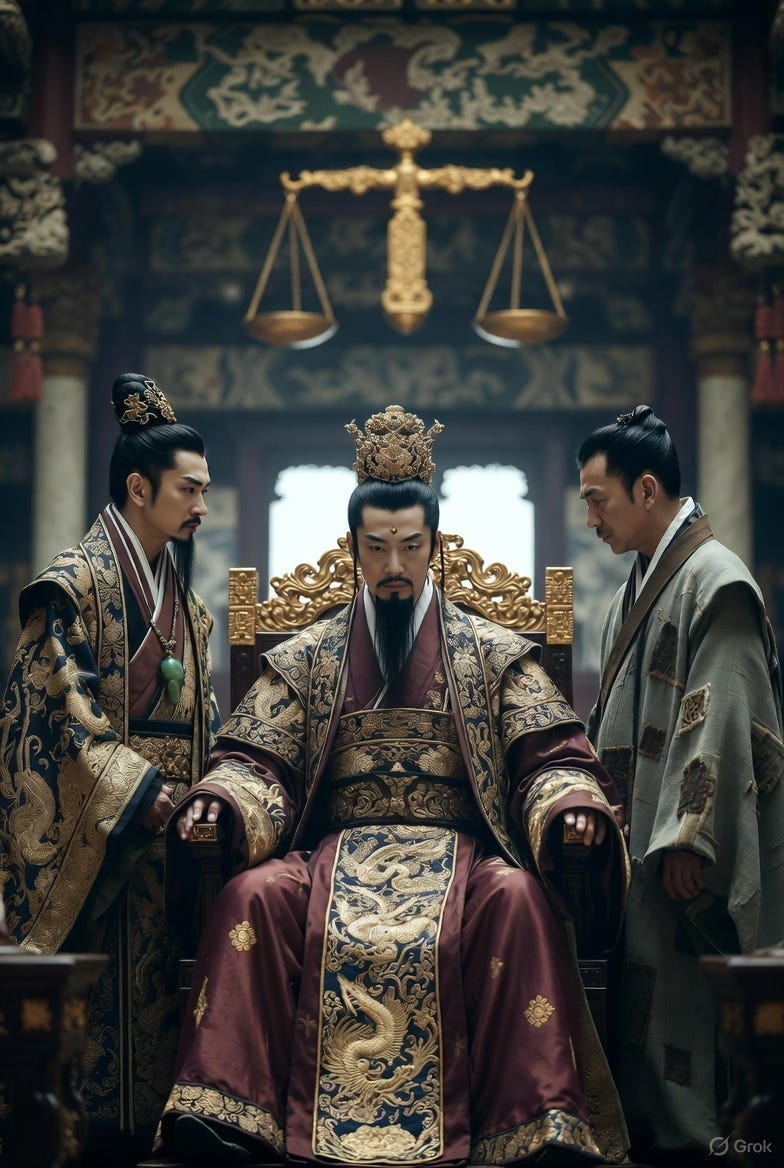
As the vast doors of the hall swung open, Emperor Liang looked up from his musings. Guards shuffled their feet as two governors of the provinces, clothing dusty from long travel, knelt before his throne. A thousand miles lay behind them, to settle a dispute by royal decree.
Wei of the Green Forests rose first, hearty and well attired. He opened his mouth in greeting, but Shen of the Grass Plains leaped up in interruption, for he had heard that he who frames the question wins the argument.
“Majesty!” spake he. “He who wields wisdom as shield and justice as sword, may you reign forever and sire a thousand sons. Behold the greatest injustice ever to cry out for redress, and give judgement. Before the great-grandfather of my grandfather suckled the milk of infancy, and before the realms were joined under the justice of the Liang dynasty, there was strife between the clans. Four centuries past, the warlords of the forest raided the villages of my ancestors, carrying many into forced labor and bondage. In their lumberyards we worked for 200 years, until the chains were struck off by the edict of your illustrious ancestor, may his progeny endure forever. The freedom of men granted, we returned to our plains. But majesty, the blood still drips from our wounds and the stripes of the past still fester on our backs. See how poor our province remains! Our children, barefooted and dirty, fight for food in our streets, while the forest children grow fat. Our young men lie worthless in the opium dens, or fall to the knives of their fellows in the dark, while the young men of the forest land study letters and learn trades. Our young women raise bastards alone, while his marry off with dowry, siring many to swell the ranks of his industries.”
“Therefore, to the justice of the Emperor we appeal. The Green Forest must pay. Let Governor Wei throw open his stores, fill the bellies of our sons and daughters, build homes for our people, and educate our children, without price and without delay. The chains of the Forest slavers still rattle in our ears, and no restitution has ever been made to feed our recovery from their abuses.” Hatred seeping from his eyes, lips twisted into the smile of victory, he stepped back into silence.
Wei of the Green Forests bowed low, and spoke with measured cadence. “Majesty, the last captive in my province was freed 150 years before I drew breath. Neither I, nor my father, nor my grandfather ever conscripted another man into labor without recompense. Yet, Governor Shen demands that I feed men who neither plow nor harvest, educate youth who will not read, house those who fell no lumber, congeal families where marriage is scorned. His wild young men leave bastards in one hut to produce more in another. As they murder one another over opium in the streets of his towns, he would lay their violence at my feet, and seek recompense from the stores of my hardworking people. Pointing to the idleness and criminality of his own subjects, he accuses me, ‘This is your doing, because long ago some of your blood wronged some of mine.’ But Lord, he confuses sequence with causation. The lash and conquest long abolished, he seeks plunder from the Green Forest to ease the poverty of a people who have made little industry in many lifetimes. They suffer indeed, but it is suffering of their own making.” For the space of long moments Emperor LIang regarded them both, his bearded chin rested upon the scepter of judgement. At last he spoke, in a strange tongue unknown to their ears. “Post hoc, ergo propter hoc.” His voice fell upon the room and resonated like a gong from the pillars of the hall. As its echo faded, he spoke again, his voice unwavering as iron.
“Rise, Governor Shen, and tell me plainly: Since the chains were struck off two centuries past, and the freedom of men etched into the tablets of my ancestors, did any later emperor forbid your people from marrying?”
“No, Majesty.”
“Were they compelled by any decree to consume opium?”
“No.”
“Did any edict forbid books to your sons, or ban them from the examination halls? Were your daughters commanded to bear children out of wedlock? Were your sons forbade, by any decree, to take up trades instead of knives?”
Shen stood in shamed silence.
“Then hear my judgement. The past is no chain to the diligent. It may reveal to us why we once fell, but cannot bind us to the ground today. The captivity of centuries past did not force your people to scorn family and fatherhood, shun the scrolls of learning, and take up poppy pipes instead of plowshares. Those choices were made last year, last week, and this morning. I will not take a grain from the stores of Governor Wei’s industrious people to feed the idle great grandsons of freed men. I will not command the thrifty to support the profligate, because ancestors long dead stood on the opposite sides of conflict. To do so would be to proclaim that a crime committed by the dead forever excuses each crime committed by the living.”
“Yet, in justice I must not forget mercy. Let any man of the Grass Plains, who resolves to marry faithfully, work honestly, shun sloth and violence, and raise offspring in a whole house be welcome in the Green Forest. Governor Wei will receive them as citizens of full right, allow them to purchase land and home on the same terms as his own people, and to learn the art of abundance from their neighbors. The door to a good life is open to all of your clan, but not one man will be carried across the thresh-hold on the back of another’s imaginary guilt. A great injustice would be mine, were I to proclaim that wrongs of centuries past are the cause of every ill that inhabits the present. It would be greater injustice still to require payment at the hands of those living and guiltless. No robbery of the diligent will be the comfort of sloth in my lands.”
“Now rise and go, both of you. The audience is ended.”
And the Emperor turned to matters of border defense and irrigation, for the preservation of empires is sealed by attendance to present duties, not breathing new life into wrongs long expired.
Galatians 6:7-8
“Be not deceived; God is not mocked: for whatsoever a man soweth, that he shall also reap.”
Marcus Aurelius, meditations 12.8
“If you are distressed by anything external, the pain is not due to the thing itself, but to your estimate of it; and this you have the power to revoke at any moment. If the cause of the trouble lies in your own disposition, correct it. If it is some old impression still rankling, erase it.”
There are many more parables where this came from. Please consider subscribing to show support and help spread the work of Apostoic.
Key Words / Search Terms
Apostoic Venn Blogcast | Apostoic | D.S. Cook | Christian Stoicism | The Emperor and the Two Governors | Apostoic Venn Blogcast Episode 20 | Post Hoc Ergo Propter Hoc | against reparations | sequence is not causation | historical grievance fallacy | Governor Wei Riverlands | Governor Shen lush plains | personal responsibility over ancestry | Galatians 6:7-8 sow and reap | Marcus Aurelius Meditations 12.8 | past is a mirror not a chain | open door without forced guilt | Christian-Stoic parable | rejecting ancestral debt | diligence vs idleness