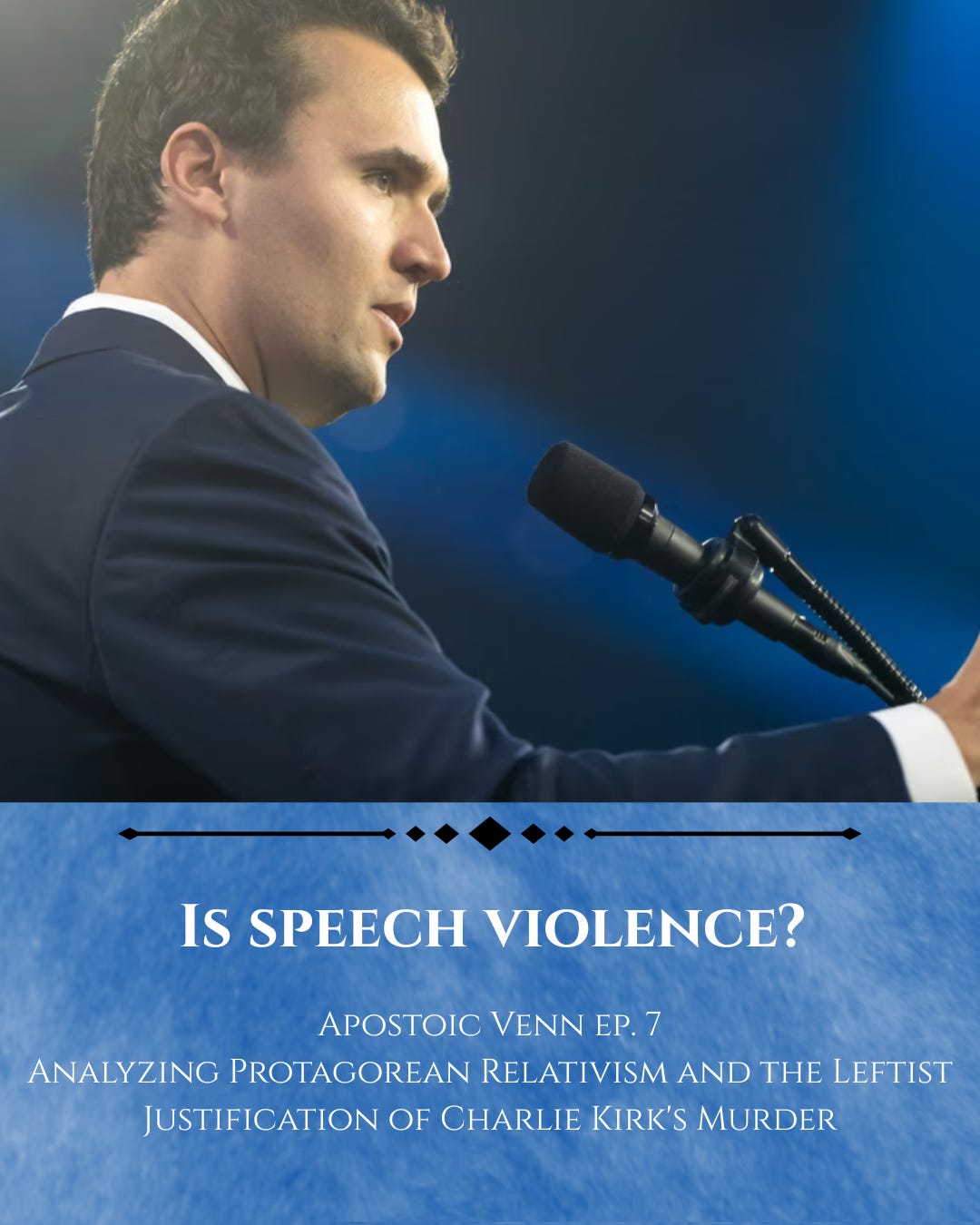
On September 10 2025, a young man sat on a chair in front of a crowd at Utah University, his voice amplified in passionate defense of his principles. As he had done so many times before, Charlie Kirk had come to discuss and debate… to hear the best arguments of those who opposed his Christian and conservative viewpoints, and engage in the act of defending and convincing with words. A bullet ripped through his neck, ending not only the life of a young father and husband, but silencing forever one of the greatest debaters and conversationalists supporting traditional American values. “He was an inflammatory figure” said his opponents in the media, “a divisive and problematic character.” They were not wrong. His words inflamed the inspiration of millions, dissatisfied with the logic and virtue of what they’ve been force-fed at universities and high schools. His words divided, drawing a clear line between those who submit themselves to God, and those who hate Him. He was problematic to his enemies, because he would win these debates. He showed that logical argument can still defeat endless repetition of false premises, and that our youth are still capable of free thought.
As his lifeblood poured from his neck, cheers rang across the American left, united in one common chorus: Words are violence. Your disagreement with us, expressed so effectively, is equivalent to a violent attack. Thus, your death is deserved, justified by the principle of self-defense. As the sexual degenerate who murdered him pronounced him “full of hate, and spreading hate,” the American left rose to echo. They announced themselves to the world as proponents of a doctrine. “Words are violence.” No supporting premises built into a logical conclusion led them to hold this as truth. No, it was repetition, the pronouncement of this claim over and over by authority figures in kindergarten, grade school, high school, and finally the almighty university.
These institutions of “learning,” many decades past, adopted Vladimir Lenin’s strategy set forth in What is to be Done? (1902). Lenin, a socialist dictator and enemy of every American value, surmised that effective propaganda for the proletariat does not require exhaustive debate, or persuasion through evidence. Rather, all that is required is the disciplined, relentless repetition of key ideas to embed them in the consciousness of the masses. “The history of all countries” he wrote, “shows that the working class, exclusively by its own effort, is able to develop only a trade-union consciousness.” To win them, one must only implant the premises one desires, over and over, relentlessly, and with enough negative consequences for dissent.
Are the university graduates of our day aware that they have been treated thus? Do they have any concept that they have fully swallowed the hook… a tactic that was set forth to their own insult? As they stand on the hill, waving Lenin’s flag, are they cognizant that the puppeteers who put them there mock them as mindless animals? No. So, it would seem, the Soviet Russian dictator who dreamed of totalitarian control was right. The once-free land of America is now largely populated by puppets who do not understand that they have never grown up. They have never matured and learned as human beings do. Rather, they have been engineered, created in a Petri dish, and are nothing but the products of a classic totalitarian assembly line. While they scream “fascist” in the faces of the few remaining thinkers, they are oblivious to their own inability to think. The very thing that separates humans from animals, the spark of the Divine Logos, has been engineered out of them by those bent on control. They are the robotic products of the very fascism they profess to hate.
A Call to Rebellious Reason
A left-leaning reader may be inspired to ire at this point. The implication of brainwashing and the lost ability to reason may be too insulting to countenance, and the strong temptation may be to click the exit button in anger, reading no further. I implore you not to do so, and give my promise to proceed in love. If you will bear it manfully, I will attempt to show you, not shout at you, that the oft repeated “speech is violence” mantra that has been hammered into your heads as dogmatic doctrine is contrary to reason. I hope to call you to some form of the rebellious spirit that shaped our great nation, the spirit that refused to be dictated, refused to simply accept the impositions and claims of authority figures without the examination of a sound mind. We are a nation built on the rebellion of reason, as our fathers employed it to reject the impositions of a king across the sea. Their rebellion of reason rejected the class system that had been practiced in societies for all of recorded history. This they tossed on the discard pile, constructing a society in which the peasant had the same vote as the nobleman. Later, other fathers did the same with the practice of human slavery, a tradition that every culture in the known world had practiced for as long as histories have been written. In doing so, they rebelled against the collective thought of all of human consciousness, that people of a different skin color were not really people. I call you to join these greats. I call you to be courageous, as they were, and bravely to employ the examination of reason against the dogmas that have been imposed upon you by the authors of your culture. It will be reason, not repetition, that shapes our minds. Be rebellious. Be courageous. Be valiant enough to think.
Moral Vacuum: The Theory of Relative Righteousness
In order to examine the claim “speech is violence,” (or “silence is violence” as the other side of the same coin) you need to first come to grips with the moral theory in which it is based. This moral theory is called “Relativism,” and has roots much further back in history than Vladimir Lenin, who dreamed of a society in which the lower classes were controlled by repetitive dogmas in their education system (congrats America, you’ve officially made it). The ancient Greek sophist Protagoras may be widely regarded as the father of relativism in philosophy, but its threads were woven together by a far older and more sinister mind than his. Protagoras posited famously that “man is the measure of all things,” asserting that truth, reality, and morality are all subjective, depending on individual perception rather than absolute standards.
There is one thing that is crucially important that you notice. This is not a scientific theory. It is a faith. One must adopt it as belief, and hold it as a matter of faith, expressly because it is unprovable by observation and untestable by any objective measures. After all, according to its own principle, there are no objective measures with which to test it. It does away with all units of measurement, and in order to test its truth, one would first have to borrow from the toolbox of objective logic. Thus untestable and empirically unprovable, it does not belong to the category of social science, it belongs to the category of cult.
This religion, a matter of blind and untestable belief, holds forth that what is good and right for me is not good and right for you. In fact, the words “good and right” are utterly meaningless, and nobody has any right to invoke them. You may claim that the kidnapping and molestation of someone else’s child is “wrong,” but you have no access to the perspective of the rapist, and have no right to impose your truth upon him. It is “right” for him, because he did it. Where man is the measure of all things, the actions of man are always in alignment with his own desire, and are always right. Your choice to donate money to feed starving children cannot be called “good” either, by anyone but yourself. All moral action is entirely subjective to the actor. To the man who believes humanity is a plague upon the earth, and that the planet would be better off without him, you have done a “wrong” thing by perpetuating the lives of children.
But it is not only the words “right” and “wrong” that lose their meanings if the religion of relativism is adopted. It is in fact all words. There is no concept that can be grasped, no principle to be examined, that cannot mean opposite things from one man to the next. What is honorable to one is dishonorable to another. What is courage to one is cowardice to another. Generosity is greed. Love is hate. Kindness is cruelty.
Once words have lost all meaning, we lose the very thing that separates us from predatory beasts, the ability to speak and reason with one another. In the same way that we can no longer define “right” as that which adheres to a set of objective moral laws, we can no longer define dog and cat, man and woman, and we can no longer define “violence” as physical harm exacted upon the body of another. It may in fact be looking at someone cross-eyed, or breathing at a cadence that is faster than what someone else appreciates. It may be that holding a different opinion, and saying so, is “violence” to that person. I have no right to say that it isn’t, in the religion of relativism. But here’s where it falls apart. Inversely, he has no right to say that my words are not kindness. If I choose, instead of using words, to butcher him in his sleep, he has no right to say that my action is not love, in the religion of relativism.
It is this chaos, this spiral into meaningless anarchy, that the liberals demand we accept. But it is a privilege they want to hold uniquely. Definitions can be flexed in whatever way the desire demands, but only their desire. Never yours.
Returning to America’s Soul: Christianity and Greek Philosophy
The great society that has made the modern socialist left into the wealthiest and safest people in all of history was not built on Marx’s philosophy, or Lenin’s. There have been cultures built on those ideas. They did not work, producing neither safety nor wealth for the proletariat, ending in mass starvation and murder. Rather, the indisputably greatest nation on earth was built on Biblical law, Christian philosophy and Greek wisdom literature (three cheers for the Stoics!).
The Biblical Anchor: Objective Truth from the Divine Logos
No serious contention can be made that America was founded on anything other than Christian values. Those who will tell you otherwise will point to outliers like Thomas Paine, trying to persuade us that a single diversion disproves the whole. Incidentally, he was neither a signer of the declaration, nor one of the authors of our constitution, but rather the writer of an influential book that helped push the colonies over the edge of complacency into revolution. Also incidentally, like all atheists, his moral compass was sourced from Christianity, whether he admitted it or not. Specifically, the biblical (and ancient Greek) understanding of the logos lies at the very heart of our nation’s founding. That truth is not a human invention, but a divine imprint, is inextricable from our founder’s thinking as they penned “One nation under God,” “endowed by their Creator with certain unalienable rights,” and “In God we trust.” This understanding, collectively agreed upon by our forefathers, is a scriptural one. “In the beginning was the Word (Logos)” reads John 1:1. This Logos, the eternal reason and rationality that not only created the universe, but inhabits every speck of it, is not subjective. It does not shift with the whims of men, is not reshaped to conform to their laws, or bend to fit the politically correct fashion of the day. This Logos has personhood, and a name. Jesus Christ is the Logic of the universe, and He is a being, not a manipulatable element. He inscribed His own reason into every cell on our planet, and each molecule bears a resemblance to His character.
It was Jesus, The Logic, who spoke the 10 commandments from above mount Sanai. They were His immutable laws, the elements of His own character, and that of the Father and the Holy Spirit, and were binding on every soul alive, Jew or gentile. His judgement of every human being that had lived or ever would live is predicated on their adherence to these 10 characteristics. All of us failed, as He knew we must. How do we know this? Because He had already promised to come and redeem us from our failure, way back in Genesis 3. His commandment, “Thou shall not murder” is to every soul on earth. Murder is not wicked because a majority votes it so, but because it stands in direct opposition and violation of the image and logic of God imprinted upon every human life (Genesis 1:27). Theft, adultery, bearing false witness, these are not evil only if the victim feels offended, and fine otherwise. They are transgressions against a holy character that precedes all human government by infinite years.
The scripture’s framing of these truths were the platform upon which the Declaration of Independence was built. Even Jefferson, a deist, a self-described Christian in morals but not in orthodoxy, acknowledged this in his famous words. “We hold these truths to be self-evident, that all men are created equal, that they are endowed by their Creator with certain unalienable rights.” This language is carefully selected, not a stream-of-consciousness journal entry at 2 a.m. Note the language: self-evident, not self determined. These rights are not granted by kings, or bestowed by nations upon themselves by popular consensus. They are inherent, objective principles gleaned from a Creator who spoke, and meant what He said. The God who spoke commandments was not doing violence thereby. Rather, he was protecting us from it. His speech is the barrier to violence, between man and man, and yes, between the wrath of God and man. God didn’t just speak these truths, He lived them, when He took on flesh and came down among us. Words, He showed us, are the very instruments of covenant, prophecy, persuasion, warning, conviction, and salvation. They are the first and last barrier to violence. Jesus did not end His many opponents with a sword, or with a hunting rifle from the top of a building on a university campus. He spoke, dismantling their errors with parables, questions, logic, and persuasion (the very tools of “violence” for which Charlie was murdered). After His opponents did use violence to stop speech that offended them, (the tool of Tyler Robinson and the millions of leftists who validated his choice), the apostles did not riot and assassinate the opposing Jews and Romans as Christianity spread throughout the world. They preached. They debated. They convicted and convinced. They used their words. The incredible spread and power of Christianity has, from the beginning, been housed in reasoning and speaking, the very “crimes” for which Charlie’s children are now fatherless.
“Speech is violence” not only flies in the face of logic, a hideous case of Nominal Conquest fallacy, but it spits in the eye of the Logos Himself, and contradicts the very structure of natural law.
The Greek Complement: Reason as the Human Distinctive
If Scripture provided the base foundation upon which United States were formed, Greek philosophy propped up its walls and roof. The wisdom of Socrates, Plato, Aristotle, and the Stoics is woven into the fabric of our national tapestry so inextricably that, setting fire to their threads, one must burn the whole canvas. These great thinkers did not regard truth as a private possession, a non-transferrable personal belief of the individual. It was a public treasure, to be shared evangelistically, and in discourse and debate. It was only by presenting wisdom to unwise minds, and doing so convincingly, that an entire society of wise voices could be built. Socrates used to wander up and down the Agora, questioning merchants and cross-examining the statements of other public teachers. Did he do this in order to cause them harm? Hardly. He wished for them a better life, and to lead them toward eudaimonia; a life aligned with wisdom and virtue is the only life that can flourish. He argued with unwise principles and practices out of pure love, not hate.
“The unexamined life is not worth living,” he said at his trial in Athens, refusing, as Charlie did, to recant his true words. Words were his tool to bring clarity and far-sightedness to the blind eyes of his people. His words did not harm them, but they certainly intended to harm him in retribution.
Seneca was not exiled from Rome because he kept his thoughts to himself. He was not chased out of that society for refusing to confront Nero with wisdom and temperance. He wrote, he spoke, he counseled Nero in the private chambers of the palace, imploring him to turn away from his mad and murderous narcissism.
The same spirit that raises its voice in favor of Charlie’s murder is the one that applauds the execution of Socrates, and the banishment of Seneca from Rome. It is not a favorable wind that blows in these hearts, but the mark of those who wish to continue in wicked and destructive paths, without the inconvenience of the voices of reason.
Aristotle too had no time for the notion of subjective truth. In his Nicomachean Ethics and Politics, he undeniably treated justice as an empirical treasure to be sought out and discovered through reason, not as something that individual preference creates by its own imagination. In other words, justice is a force that exists outside, not within, the human whim, and can be observed by inquisitive interest in what has been created, not by our minds, but by the architect of this universe.
Christianity and Greek philosophy. This fusion produced, among many other foundational writs, the First Amendment of our Constitution. “Congress shall make no law abridging the freedom of speech or of the press.”
Why not? Why would this be bad? Because uninhibited exchange of ideas is the only way to sharpen and improve the societal consciousness, and the only way that a free Republic can thrive, or even survive. Aping Aristotle, James Madison wrote in Federalist No. 10 that factions do indeed arise in the freedom of diverse opinion, but silencing them is no remedy whatever. No suppression will keep us from tearing one another apart, but deliberation: an “extended Republic” where truth emerges from the “collision of ideas.”
Think about that phrase. The necessary “collision of ideas.” Disagreements, and strong ones, Madison viewed as vital for the survival of our nation. It is by silencing and siloing its thinkers that a country collapses, and by throwing wide the gates of the free market of ideas that it stands. It is a very hopeful position. Madison had great faith in the people’s ability to think; that under a principle of mental capitalism, the best and truest ideas will rise to the top and stand the test of time.
“Violence” enters only when arguments cease, and are replaced by fists and tools of war. This is the means of silencing opponents, and it is the means employed by Tyler Robinson and the mainstream Left he represents. Continue to suppress the voices of opposing thinkers, and you accomplish nothing but to hasten the day when war, not speech, will determine America’s future. We who uphold the Logos simply will not lie down, and be ruled by folly and non-truth. Your murder of Charlie Kirk, a saint and a hero of conservative thought, has only served to harden your neighbors against you, and make us readier than before to hold fast to truth and reason by means of arms. It would be a civil war that your purple-haired white women and feminized man-boys could not win.
“Speech is Violence” Dismantled by the Rational Faculty
By the principles we have just discussed, Greek rationality and the words of the Logos in scripture, speech is not violence. Definitionally, speech is not violence. Examined rationally, the implications of the idea are as follows.
Speech is the communication of ideas from one person to another. Violence, by definition, is physical action intended to do harm or injury. Regardless of the degree to which debate becomes heated, it leaves its practitioners with no broken bones or bruises. To force speech under the umbrella of violence, you must redefine it via Nominal Conquest Fallacy. Then, you must redefine “broken bones and bruises” to include hurt feelings. Then you must redefine hurt feelings to include “having been disagreed with.”
This creates an indefinite loop of redefinition, the inevitable Protagorean chaos. But eventually, as you discovered with your liberal application of the words “racist” and “nazi,” if everything is “harm”, then nothing is “harm.”
If speech is violence, then the thought that produces it is violence. If thought is violence, then the breathing and eating of food that are its prerequisites are also violence. If breathing and eating are violence, then the existence of other people is violence. Not one person, conservative or liberal, will agree with your views entirely and exactly.
Unequal justice reigns. The supporters of Charlie Kirk’s assassin claimed self-defense against “hate speech,” widely and loudly. Yet under the ridiculous laws of relativism, they have no grounds to impose an objective categorization on Charlie’s truth. If, to Charlie, this same speech was love and kindness, they have no objective measurements by which to deny it, according to the laws of their own relativist religion. Who then will arbitrate between these malleable and subjective truths, which are incompatible and mutually exclusive? The one with the gun.
This is might-makes-right in poor disguise, not justice. It is the law of the jungle masquerading as “progress.”
Free civilization implodes and collapses. If disagreement is equal to assault, then every campus is a crime scene, every election is a civil war. Families are engaged in domestic abuse each time they argue over sports or movies at the dinner table.
This insane and untenable idea, applied only selectively by the left, is rank with hypocrisy on every level. They want to hold that falsely accusing opponents of being Nazis is free speech, but “misgendering” a man pretending to be a woman is not just violence, but “genocide.” Again, Nominal Conquest Fallacy is their primary weapon, and relativism is not a tool for principle, but for power and force.
History testifies against it. Historic regimes that equated verbal dissent with crime include Stalin’s political purges, Hitler’s Gestapo and SS, Mao’s Cultural Revolution, the Spanish Inquisition, the French Revolution. This is the illustrious company that the left seeks to join, in their attempts to label dissent as Orwell’s thought-crime. These regimes tortured and slaughtered their own people; murdered millions for the crime of disagreement, the unforgivable habit of offending the powerful.
America’s greatness is not only built upon, but dependent upon, the manly sufferance of offense. When the Christian right called slavery sinful and wicked, and accused slave owners of evil and inhumanity, it was extremely offensive to them. But it was not violence. It was the attempt to stop violence, the final plea to let speech and persuasion, not war, determine the future for America.
“Woe to those who call evil good and good evil, who put darkness for light and light for darkness, who put bitter for sweet and sweet for bitter.” (Isaiah 5:20). In the cavernous, sucking moral vacuum that is left behind by relativism, the assassin is the hero, the debater is the criminal. The predator is the victim, and the protector is the perpetrator. The murderer of infants is the brave, and the defender of the innocent is the bigot.
The Logos is coming to judge the quick and the dead, and He will not deal lightly with the twisting of evil into good. There is time yet to find anchorage in His objective truth, the law of God and the rational faculty that He gave to His image-bearing creations. By His decrees and very character, Charlie’s words were love, not hate, exposing heinous wickedness in order to save his compatriots lives and souls. The bullet that killed him was hate, silencing a voice speaking truth, to the end of preserving perversity, sexual license, and selfish living. In the end, Charlie’s love became ultimate, as he lay down his life for his friends. Greater love has no man than this.
A Final Plea, Choose Life, Choose Reason: Charlie’s Gospel
Charlie Kirk died defending the right to speak truth in a nation that once prized it above personal gratification and comfort. His blood cries out for vengeance, but not from us. “Vengeance is mine, saith the Lord.” Reject the proletariat assembly line of Lenin’s repetition. Embrace the rebellion of reason. Read the Bible not as mythical fiction, but the mandate of the Logos long known to mankind. Study the Greeks not as relics of the ignorant ancients, but the very building blocks that formed the free society that allows your diversity of opinion. Define violence as it is: It is the bullet, not the ballot, the fist, not the phrase. The choice is yours to either remain a totalitarian puppet, or rise as a free thinker.
But most importantly, hear this. Charlie was a fallen man, a repentant and forgiven sinner. He, like us here at Apostoic Venn, fell short of the glory of God. But Christ, in an act of ultimate love, took on flesh and laid His life down to pay the penalty for our wickedness. In doing so, He satisfied divine justice and paid the due penalty for our words and deeds. He bought Charlie at a great price. Repent, believe in the Lord Jesus Christ, and be baptized for the remission of your sins, and the same grace offered to Charlie Kirk, and to Sam and Dan of Apostoic Venn, is offered to you. Rise and avail yourself of it, oh fellow wielder of wickedness, before the judgement of the Lord comes upon you.
God bless Charlie Kirk. Rest in peace, my brother.
Key Words / Search Terms Apostoic Venn Blogcast | Apostoic | D.S. Cook | Christian Stoicism | Was Charlie Kirk’s Speech Violence? | Apostoic Venn Blogcast Episode 7 | Charlie Kirk assassination | speech is violence | words are violence | moral relativism | Protagoras man is the measure | Lenin What is to be Done | proletariat propaganda | rebellion of reason | objective truth vs relativism | Biblical Logos | John 1:1 | Greek philosophy free speech | Socrates examined life | Aristotle justice | First Amendment speech | Charlie Kirk debate | Utah University shooting | Christian conservative viewpoints | free speech not violence | relativism moral vacuum | American founding philosophy | Judeo-Christian foundations | call to reason