

By Dan Cook and Sam Davis for Apostoic Venn blogcast.
Part 1: Damned if you do
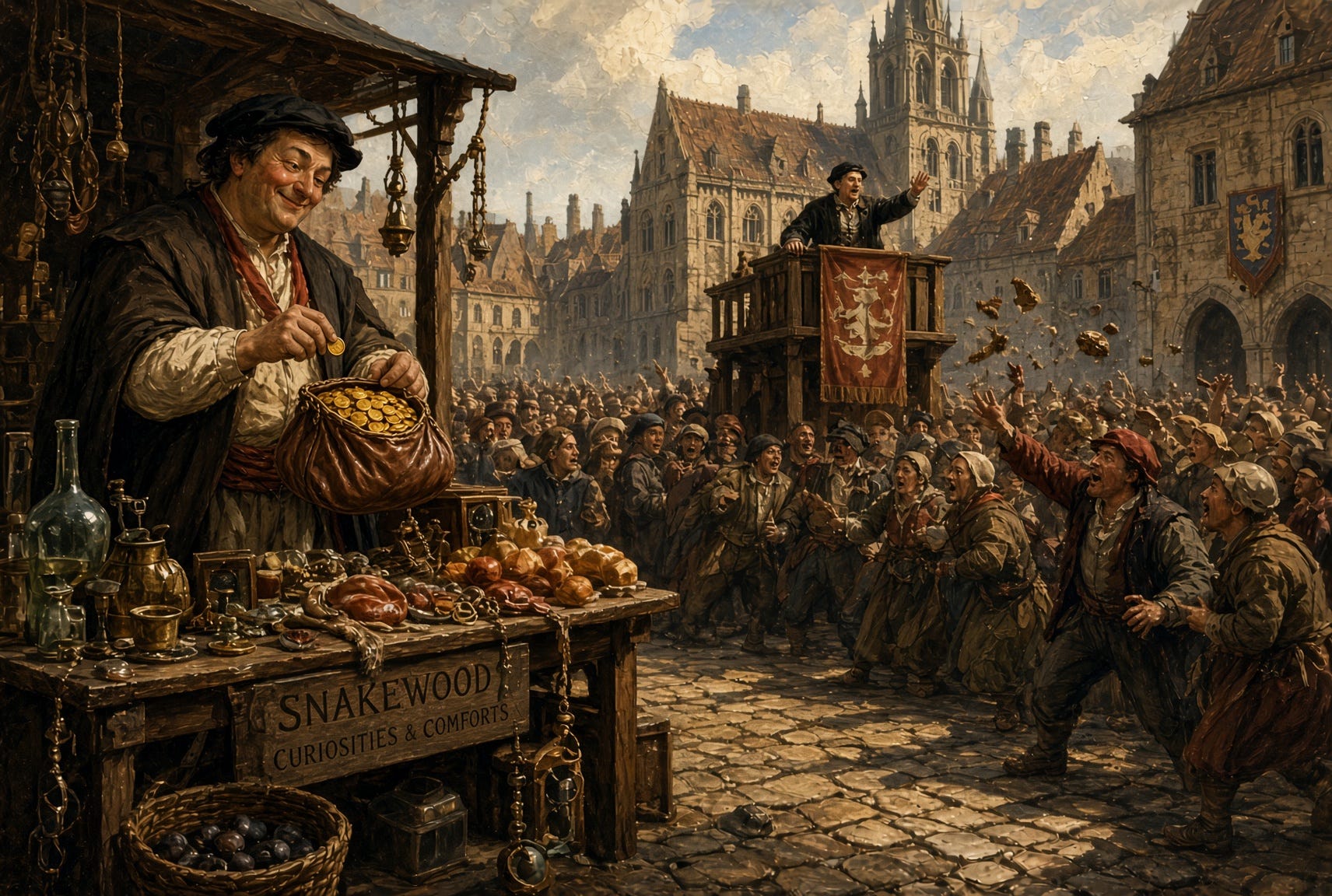
Once in a great city inhabited by many thousands, a merchant destined for greatness, but never goodness, peddled trinkets around a bustling city square. It was a gracious city, where freedom was prized and tolerance touted, and thus a hub for men and women of every politic and creed.
One early morning, the merchant sprung upright in his bed, and shook his wife awake. “Good wife!” He exclaimed, “A dream has visited me in the night, a great revelation. Methinks I know a road to greater wealth than we have hitherto imagined. I would dress thee in fine silks and surround thee with many servants. Prepare to cast off thy modest living and ascend amongst the nobility of this city.” His wife, having heard such before, rolled over and issued a groan. “What is it husband? Have you not heard that a wife woken early is a bad omen on the day?”
“Hist,” said her husband, ambition gleaming. “I shall set down my pack and my cart this day, and build for myself a stall and podium.”
“A stall is easily built of any wood,” said the wife. “But of what good is a podium to a peddler such as thee?”
“Hold, and hear genius. The stall I shall set in the square, at a place that I know upon my steady route. Then shall I clear space around, and set my podium in easy sight. There, I shall invite proselytizers of every stripe, to speak to any and all who pass by. To the crowds that pause there, I myself shall pedal, and multiply our coffers manyfold.”
“And what will be the cost of these hired instruments?” His wife asked, sitting up.
“Therin lies the brilliance of my scheme. Not a penny will I offer, but the chance to have their prating voices heard by many. So prospected, they will line up unasked to fill my pulpit. No more shall be given the listeners, for I shall turn intrigue and dissent to entertainment. In hearkening or hatred, I will sell my refreshments to all under the hot sun.”
“It strikes me, husband, that you set too little by the intellect of your fellows.” She yawned, disbelieving.
“Wife, by their intellect I set an exact sum.”
He shirked his route that day, and set to work constructing a fine stall of snakewood. From the same material he crafted an elevated platform and podium. By week’s end, both were set in place, the first loaded with worthless trinkets and foodstuffs, and the second commanding a fine vantage of the square.
First to stop was a seamstress. “For what is this podium?” she asked.
“Why, it is for you!” said the merchant.
“For me? To what end?”
“That you might speak to all who pass by on the topic of your choosing. I can see by your look that you are a woman of wisdom and skill, and surely the whole square would benefit.”
“Indeed!” said the woman. “I am rather bright, but so few take notice.” And up she stepped to the podium, to deliver a rousing speech on which needles make the neatest stitches. One or two disinterested citizens stopped near, for a few moments, to see what manner of curiosity was afoot. They passed quickly on. “Thank you!” said the merchant. “Your brilliance is boundless, and if you were to repeat the feat tomorrow, why, I am certain your knowledge will travel.” The woman trundled off, already thinking about the morrow.
The next to stop was a philosopher of small repute. To his query, the merchant again gave answer: The podium, of course, was for him. Up he got, to deliver a monologue “on just what it is to truly understand the inhabitation of being, before one’s being can inhabit understanding itself.” A small cluster stopped for the space of some moments, laughing and scratching their heads in bewilderment, and one to feign understanding in his fellows’ eyes. “Thank you!” said the merchant. “Your enlightenment is beyond reproach. It is certain that if you can repeat the feat tomorrow, word will spread.”
The third was a man learned in the holy texts of the many gods of his homeland. He stood up to deliver a scathing rebuke of all those who sacrificed to no deity, or to but one. For him, a small crowd gathered not to appreciate, but to detract and dissent according to the words of their own holy texts. The merchant rubbed his hands together with glee, as his refreshments began to soothe their sore throats.
The crowd doubled for the fourth, then redoubled, as he hurled accusations at a rival. “His criminality is outpaced by his perversity alone!” He shouted. “Down with him. The city must have a man for the people!” The square was filled with cheers, jeers, and shouts of rage, but the merchant hummed to the jingle of coin.
Upon the morrow, a line of speakers awaited the podium, some new, some come again. Then for the next many days, his coffers swelled. He spoke again with his dumbfounded wife, as he tipped coins into her open palms. “See there, doubting wife. Your husband has more than one wit about him. What say you?”
“A woman, with jewels such as I will wear, can say whatever she wills!” Said the wife. “What craft you have, and what fools you serve.” “Aye,” said the merchant, “but strike the nobles from thy ambitions and set thy sight on queens, for in the success of my plot, I have learned anew. I know what manner of speech swells the crowd best, and shall promote nothing else from now. What’s more, I have in my aim to set down many stalls, and many podiums to match, ‘til my crowds fill the square. Best take thy coins and procure bigger purse.”
And so, according to this plan he progressed. As time passed, he began to stipend those most able to bring a crowd, and in turn, they responded with speeches ever more divisive and outlandish, as the surest means of filling the square and their own pockets. For, it mattered not to speaker nor merchant whether the host of hearers opposed or upheld, only that they came again and again. And thus, the once happy city was driven apart into silos of mutual hatred, ever widening and outdoing one another in extremity. The whole of the city square was overtaken by the merchant’s ploy, and the people learned from nowhere else. Long before the city would fall to civil strife and irreconcilable polarity, the scheming merchant and his spouse were set high above kings in wealth, and now wielded avarice over not cart and pack, but many nations.
Moral:
How much better it were, for that society, to decline the merchant’s podium and shun attendance of that square? Damned if you do.
*******************************************************************************************************
Part 2: Damneder if you don’t.
There were in those days certain disciples inhabiting that great city, bound together by the words of most ancient of wisdom. Very many they were, but spread, inhabiting this corner and that, but rejoining to offer sacrifice and thanksgiving. For they belonged to a Creed before all creeds; worshipers of a Deity that stood alone above all others in power and precedent. This God had issued a final command, a Great Command, as a charge to all who would follow. Wherever you go, He said, and whatever you do, you must never be silent, but speak of Me. Never did He lay the blame of reception at their feet, nor hold them accountable for the closed ears of their fellows. But to speak He did command them, and that without faltering or ceasing. Such a disciple was in the square, conversing with those who would hear, when the first podium was erected. With a few fellows he stood as the crowd doubled and doubled again.
Said he to his companions, “I will take up this perch, God help me, and speak as the Lord has commanded.”
“Stay a moment” said another. “I like not the way this wind is blowing. The merchant yonder appears altogether too merry at the cries of the mob.”
“Yet will I go.” Said the man. “If a peddler’s pleasure be the price of such an audience, let him smile on.”
Up he strode, and spoke plainly. But the crowd grew only more clamorous, the loudest united in revulsion of his words. His attempt the following day met with insult and curse, and the third with a hail of refuse.
At last, sorely harried and shamed, he spake to his fellows. “I’ll go no more into that square, nor speak from that summit. The Lord’s words fall upon deaf men, and not reason or plea will reach them. Sinking in quicksand, they inspect the saving rope and call it cobra. I’ll feed no more the greedy merchant, who profits by multiplying strife. I’ll fuel no more the revilers of our God, who drift further daily while His words remain unmoved. Pearls before swine, the wise man once said, and our time is better spent at home and assembly.” With this, one by one did his fellows agree. Forgotten was the Great Command. So wearied they were, absent success, that they forgot that success was never commanded. And thus, the square was emptied of the ancient wisdom.
But worse for them was quick in coming, and they unsuspecting. Soon all the merchants of that city, and its governors and princes, learned only at the school of the merchant’s square. It was there they learned what manner of citizens they had, and what desires were theirs. It was there they took census, making policy and product to accommodate. With little representation of the ancient way, they steered without its consideration.
Soon the laws of the king were crafted to do what is right in the eyes of a mob unmetered. The disciples having resigned the wicked to do wickedly, and declined themselves to speak, robbed the kingdom of the representation of reason, and gave over their nation to those who found no odium in the podium.
Soon the aspiring official, schooled in the square, found that popularity is bred from extremity.
Soon the merchants of that land, seeking only lucre, their only law demand and supply, catered to a market off-kelter. They hearkened to the only voice they heard, ere long hocking codpieces for women and bustles for men.
Soon after, the ancient way was all but banned from the square.
Soon, things unspeakable were required from the lips of every worker, and expected as the normative of every citizen. Disciples who would not make utterance were met with shock and disbelief, as if beings never before encountered. Soon they bore false witness to their own beliefs, cowered in ignominy, or found their bread in the gutters.
Soon, new leaders gained office on popular principle, unaware or uncaring that it was last year’s most egregious extremity, accelerated to normalcy by the absence of challenge.
Soon, a new generation of children came of age to cast ballot. Raised in the square, they thought its wicked principles the floorboard of decency, and sought only to advance further.
The disciples had abandoned obedience. It was to speak that their Master had charged, not to succeed. In distaste for the medium, they discarded the means. And while the Master would not lose one chosen lamb, a holy post was forsaken whose purpose extended beyond the retrieval of lambs. It was not only evangelism, but representation in the new world, the counterweight that would balance the toppling scale of culture, and give protection to the next generation from a world entirely ignorant of, and entirely hostile to truth. Rebelling against the new reality of the merchant’s square, and rightly resenting the unworthy profit to the schemer, the disciples unwittingly handed both hammer and shield to the enemies who would abolish their last stronghold, crush their children underfoot, and reduce them once more to a remnant.
Meta-moral:
How much better it were, once the merchant’s square lived irreversible, for every pagan voice to be matched by a capable Christian? Damneder if you don’t.

Apostoic Venn has no paid subscription tiers, all content is free. Please subscribe to help support and spread our work.
We make nothing, and have a lot of expenses in the making of this content. If you’d like to help, please pick up some merch from the pop-up store below. New designs weekly.
Apostoic Venn Store

Key Words / Search Terms
Christian social media engagement | parable of the maleficent merchant | damned if you do damneder if you don’t | should Christians speak online | Great Commission and social media | Christian public witness | cultural representation | polarization for profit | engagement algorithms | public square discourse | Christian silence | countercultural speech | discipleship and media | defending the faith online | cultural decline | moral parable | social media and the church | speaking truth in public | Christian cultural influence | profit from division | Apostoic Venn | Dan Cook | Sam Davis